
GEO vs. SEO vs. AEO: Which Should Your Service Business Prioritize in 2026?
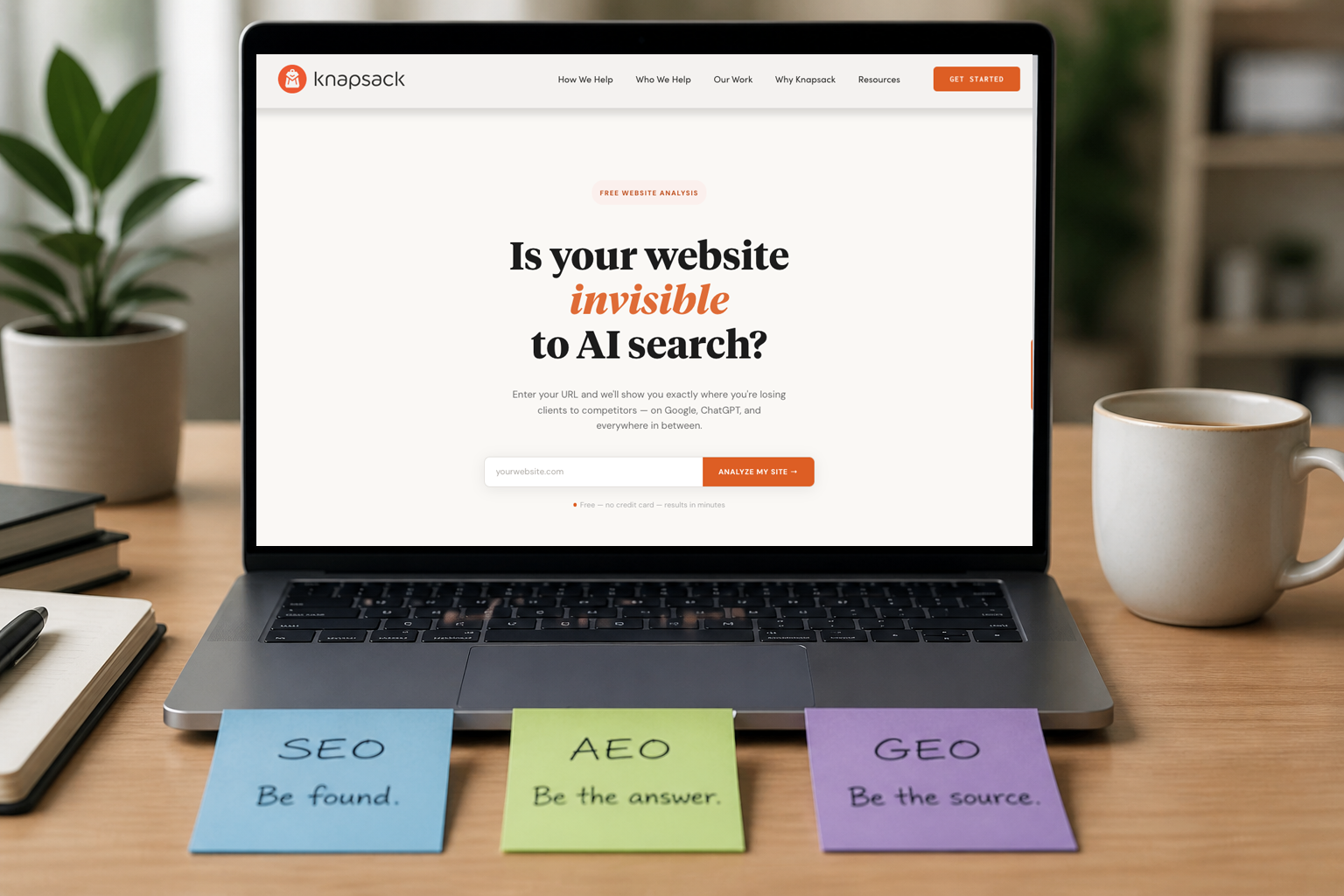
When you hire a custom website design agency, you invest in a beautiful website with the expectation that it will drive growth, but what happens when the phone isn’t ringing as much as it used to? Search behavior has fundamentally changed. Your potential clients are no longer just scrolling through Google; they are asking Siri for local recommendations, reading AI summaries, and getting direct answers from ChatGPT.
Suddenly, you are hearing a bunch of new acronyms: SEO, AEO, and GEO. If you feel overwhelmed by the shifting digital landscape, you aren't alone. But here is the good news: these aren't three completely different marketing channels you need to manage separately. They are connected layers of modern search visibility.
As a Professional StoryBrand website design agency, we help service businesses cut through the tech jargon and master their comprehensive guide to digital presence. Let’s break down exactly what these terms mean, how they work together, and where you should focus your energy in 2026 to keep your pipeline full.
Three Layers of Modern Search
Traditional search shows links. Modern search shows answers. To capture leads today, you need to understand how users are finding you at different stages of their journey.
1. SEO (Search Engine Optimization): The Foundation
SEO is the practice of optimizing your web pages to rank higher in search engines like Google. Even with the rise of AI, Google remains the primary discovery engine for high-intent, local service searches.
How it works in 2026: Search engines no longer just count keywords; they evaluate how well your page answers the user's underlying intent.
Local SEO: Optimizing your Google Business Profile to capture "near me" searches.
Service Pages: Creating dedicated, deep-dive pages for each service you offer.
Technical Health: Ensuring fast load times and flawless mobile responsiveness.
The Knapsack Advantage: Building your site on a modern platform like Squarespace 7.1 automatically handles the heavy lifting of technical SEO, giving you a clean, fast foundation from day one.
2. AEO (Answer Engine Optimization): The Direct Answer
AEO focuses on providing immediate, direct answers to user questions so your business can be featured in Voice Search (Alexa, Siri) and Google's "Featured Snippets" (the box at the top of the search results).
How it works in 2026: Instead of showing multiple links, answer engines pull a single, clear response from a highly structured website.
Structured Content: Using clear H2 and H3 headings to break up text.
FAQ Sections: Directly asking and answering the exact questions your clients have.
Schema Markup: Using background code to explicitly tell search engines what your content means.
When you optimize for AEO, you capture "zero-click" searches. Users get their answer immediately, positioning you as the undeniable authority before they even visit your site.
3. GEO (Generative Engine Optimization): The AI Citation
GEO focuses on getting your brand cited in AI-generated responses on platforms like ChatGPT, Perplexity, and Google's AI Overviews.
How it works in 2026: Generative AI doesn't list websites; it reads them, synthesizes the information, and generates a custom answer. It decides who to cite based on:
Topical Authority: Do you cover your specific niche in depth across your site?
Trust Signals: Is your brand mentioned consistently across directories, reviews, and credible platforms?
Context over Keywords: Does your content clearly define who you are and what you do?
SEO vs. AEO vs. GEO: Key Differences
Factor |
SEO (Search) |
AEO (Answers) |
GEO (Generative AI) |
|---|---|---|---|
| Primary Goal | Rank pages high in search results | Provide the definitive answer | Get cited as a trusted source |
| Output | A list of clickable links | A single, direct answer | An AI-generated summary |
| Focus | Keywords & Search Intent | Structured FAQs & Clarity | Context, Authority & Mentions |
| Result | Website Traffic | Immediate Visibility | Brand Trust & Citations |
Which Should You Prioritize?
The short answer: You cannot choose just one. If you focus only on SEO, you miss the growing wave of users who are asking AI for recommendations. If you only focus on GEO, you neglect the massive amount of traffic still coming from traditional Google searches.
A single, well-structured service page should accomplish all three:
It ranks well on Google thanks to strong SEO.
It answers common client questions through AEO.
Its clear structure and authority get it referenced in AI tools through GEO.
The Action Plan for Service Businesses
If you need traffic now, focus heavily on your SEO foundation and local service pages.
If you want to build instant trust: Structure your content for AEO with direct, jargon-free answers.
If you want future-proof visibility, invest in GEO by consistently publishing authoritative content and keeping your brand presence clean across the web.
Stop Guessing. Start Growing.
Your website should do more than just look pretty. It needs to clearly communicate your value so that humans, search engines, and AI models all know exactly why you are the best choice.
At Knapsack Creative, We Design Premium Squarespace websites rooted in the StoryBrand framework. We build the SEO foundation, structure your content for AEO, and optimize your messaging for GEO, all so you can focus on running your business.
Is your website invisible to AI search?
ChatGPT and Gemini are sending your clients to competitors right now. Don't guess where you stand, know for sure.
Find out if your site is AI-ready in less than 3 minutes. Grab your complimentary AI visibility report to uncover exactly where your competitors are stealing your leads in AI search and get the exact steps to win them back.
Want a website that actually works for your business?
If you are ready to stop losing traffic and start booking more clients, we are here to help. Let our team build you a custom, high-performing website with a crystal-clear message that stands out across every modern search platform.
FAQs
1. How should a service business adapt its SEO strategy for AI-driven search like ChatGPT and Google AI Overviews?
Service businesses should expand beyond traditional SEO by structuring content for both search engines and AI systems. This includes creating clear, intent-driven pages, adding FAQ sections, and building topical authority. AI platforms prioritize context, consistency, and trust signals, so your strategy should combine SEO for rankings, AEO for direct answers, and GEO for AI visibility.
2. What type of content is most likely to get cited in AI-generated answers (GEO)?
AI systems prefer structured, fact-based content that covers a topic in depth. Long-form pages with clear headings, supporting subtopics, and consistent terminology perform better. Content that appears across multiple trusted sources, including directories and authoritative websites, is more likely to be referenced by AI tools.
3. Why is my website ranking on Google but not appearing in AI search results?
Ranking on Google does not guarantee visibility in AI-generated answers. AI systems evaluate authority, consistency, and entity recognition across the web. If your brand lacks mentions outside your website or your content is not structured for clarity, AI platforms may not use it as a source.
4. How do SEO, AEO, and GEO impact lead generation differently for service businesses?
SEO drives traffic by helping users find your website through search results. AEO improves conversion by answering questions directly and building trust. GEO increases brand visibility on AI platforms, influencing decision-making even without direct clicks. Together, they create a complete lead generation system.
5. What is the biggest mistake businesses make when trying to optimize for AI search?
The most common mistake is focusing only on keywords while ignoring structure and authority. AI systems do not rely only on keyword matching. They prioritize well-organized content, clear answers, and strong brand signals across platforms. Without these elements, content is less likely to appear in AI-generated responses.